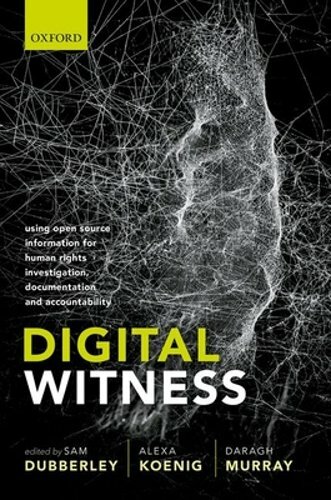
Digital Witness by Alexa Koenig – Open Source Human Rights Investigations Hardcover 2020

$ 100.53

Reviews: Chapter 4: Open Source Investigations and the Technology-Driven Knowledge Controversy in Human Rights Fact-Finding, was awarded the International Studies Association's 2021 Human Rights Best Paper Award."In this compelling volume, beautifully edited by Sam Dubberley, Alexa Koenig, and Daragh Murray - and featuring the contributions of leading scholars, experts, journalists and lawyers - the role technology can now play in sharpening our investigations into gross human rights abuses is examined in commendable detail. The contributors to Digital Witness have, much to their credit, analyzed meticulously all significant and relevant angles. It is a volume that will fast become the standard text for anyone interested in human rights, the collection of evidence in the digital age, and the prosecution of those who perpetrate gross human rights violations." -- Prince Zeid Raad Al Hussein, UN High Commissioner for Human Rights (2014-2018)"Digital Witness demonstrates, as no other volume has done, how the digital age has opened up vast new opportunities for accountability. It shows how journalists and human rights researchers are solving mysteries that once seemed unsolvable, from responsibility for terrorism to the identity of perpetrators and victims of international crimes. Fact-finders no longer only travel to the front-lines of battle or trudge through dusty archives; they can learn, verify, preserve and explain using openly available digital tools. With expert input from around the world, Digital Witness is bound to become a key source for open source investigators DL and for students and professionals aiming to make visible what previously has only been hidden." -- David Kaye, United Nations Special Rapporteur on the Promotion and Protection of the Right to Freedom of Opinion and Expression"Digital Witness is an essential piece of guidance/reading, as it captures what anyone who believes in the truth as a tool for justice, must know. In a world rife with disinformation and overwhelmed with large volumes of videos documenting human rights abuses, this book pragmatically and effectively provides us with roadmap to make it possible for a "cameras everywhere" world to lead to/become a just world. For anyone who is a civic witness, an investigator, an activist, or a lawyer, or an ordinary person who has ever seen or shared an eye witness account capturing a human rights abuse, Digital Witness is essential reading. What the authors have done is make us understand the very concrete ways that open source information can deliver justice - it is both an essential roadmap and a much needed guide. So that, when the world witnesses human rights crimes, the promise of technology in service of human rights, can be realized." -- Yvette Alberdingk Thijm, Executive Director of WITNESS"The acceleration of armed conflict has also amplified the information it generates. ['e¦] in near real time, as events unfold and on the terms of those producing them. This creates and embroils them in a secondary conflict ['e¦]. When attempting to analyse and investigate events, noise, propaganda, disinformation and bias get dangerously entangled with valuable first-hand testimonies. Human rights investigators and conflict monitors must therefore match the speed of contemporary conflict and the agility of information technologies. They can no longer afford to only engage with the gathering of testimonies well after the fact, but must develop skills in real time analysis ['e¦]. How great it is, then, that the editors of this book have gathered a group of pioneering practitioners and scholars, to produce what is a guide book for both activists and investigators and for all students of our saturated visual cultures." - Eyal Weizman, Director of Forensic Architecture, Chapter 4: Open Source Investigations and the Technology-Driven Knowledge Controversy in Human Rights Fact-Finding, was awarded the International Studies Association's 2021 Human Rights Best Paper Award. "In this compelling volume, beautifully edited by Sam Dubberley, Alexa Koenig, and Daragh Murray - and featuring the contributions of leading scholars, experts, journalists and lawyers - the role technology can now play in sharpening our investigations into gross human rights abuses is examined in commendable detail. The contributors to Digital Witness have, much to their credit, analyzed meticulously all significant and relevant angles. It is a volume that will fast become the standard text for anyone interested in human rights, the collection of evidence in the digital age, and the prosecution of those who perpetrate gross human rights violations." -- Prince Zeid Raad Al Hussein, UN High Commissioner for Human Rights (2014-2018) "Digital Witness demonstrates, as no other volume has done, how the digital age has opened up vast new opportunities for accountability. It shows how journalists and human rights researchers are solving mysteries that once seemed unsolvable, from responsibility for terrorism to the identity of perpetrators and victims of international crimes. Fact-finders no longer only travel to the front-lines of battle or trudge through dusty archives; they can learn, verify, preserve and explain using openly available digital tools. With expert input from around the world, Digital Witness is bound to become a key source for open source investigators -- and for students and professionals aiming to make visible what previously has only been hidden." -- David Kaye, United Nations Special Rapporteur on the Promotion and Protection of the Right to Freedom of Opinion and Expression "Digital Witness is an essential piece of guidance/reading, as it captures what anyone who believes in the truth as a tool for justice, must know. In a world rife with disinformation and overwhelmed with large volumes of videos documenting human rights abuses, this book pragmatically and effectively provides us with roadmap to make it possible for a "cameras everywhere" world to lead to/become a just world. For anyone who is a civic witness, an investigator, an activist, or a lawyer, or an ordinary person who has ever seen or shared an eye witness account capturing a human rights abuse, Digital Witness is essential reading. What the authors have done is make us understand the very concrete ways that open source information can deliver justice - it is both an essential roadmap and a much needed guide. So that, when the world witnesses human rights crimes, the promise of technology in service of human rights, can be realized." -- Yvette Alberdingk Thijm, Executive Director of WITNESS "The acceleration of armed conflict has also amplified the information it generates. [EL] in near real time, as events unfold and on the terms of those producing them. This creates and embroils them in a secondary conflict [EL]. When attempting to analyse and investigate events, noise, propaganda, disinformation and bias get dangerously entangled with valuable first-hand testimonies. Human rights investigators and conflict monitors must therefore match the speed of contemporary conflict and the agility of information technologies. They can no longer afford to only engage with the gathering of testimonies well after the fact, but must develop skills in real time analysis [EL]. How great it is, then, that the editors of this book have gathered a group of pioneering practitioners and scholars, to produce what is a guide book for both activists and investigators and for all students of our saturated visual cultures." - Eyal Weizman, Director of Forensic Architecture, Chapter 4: Open Source Investigations and the Technology-Driven Knowledge Controversy in Human Rights Fact-Finding, was awarded the International Studies Association's 2021 Human Rights Best Paper Award."In this compelling volume, beautifully edited by Sam Dubberley, Alexa Koenig, and Daragh Murray - and featuring the contributions of leading scholars, experts, journalists and lawyers - the role technology can now play in sharpening our investigations into gross human rights abuses is examined in commendable detail. The contributors to Digital Witness have, much to their credit, analyzed meticulously all significant and relevant angles. It is a volume that will fast become the standard text for anyone interested in human rights, the collection of evidence in the digital age, and the prosecution of those who perpetrate gross human rights violations." -- Prince Zeid Raad Al Hussein, UN High Commissioner for Human Rights (2014-2018)"Digital Witness demonstrates, as no other volume has done, how the digital age has opened up vast new opportunities for accountability. It shows how journalists and human rights researchers are solving mysteries that once seemed unsolvable, from responsibility for terrorism to the identity of perpetrators and victims of international crimes. Fact-finders no longer only travel to the front-lines of battle or trudge through dusty archives; they can learn, verify, preserve and explain using openly available digital tools. With expert input from around the world, Digital Witness is bound to become a key source for open source investigators -- and for students and professionals aiming to make visible what previously has only been hidden." -- David Kaye, United Nations Special Rapporteur on the Promotion and Protection of the Right to Freedom of Opinion and Expression"Digital Witness is an essential piece of guidance/reading, as it captures what anyone who believes in the truth as a tool for justice, must know. In a world rife with disinformation and overwhelmed with large volumes of videos documenting human rights abuses, this book pragmatically and effectively provides us with roadmap to make it possible for a "cameras everywhere" world to lead to/become a just world. For anyone who is a civic witness, an investigator, an activist, or a lawyer, or an ordinary person who has ever seen or shared an eye witness account capturing a human rights abuse, Digital Witness is essential reading. What the authors have done is make us understand the very concrete ways that open source information can deliver justice - it is both an essential roadmap and a much needed guide. So that, when the world witnesses human rights crimes, the promise of technology in service of human rights, can be realized." -- Yvette Alberdingk Thijm, Executive Director of WITNESS"The acceleration of armed conflict has also amplified the information it generates. [...] in near real time, as events unfold and on the terms of those producing them. This creates and embroils them in a secondary conflict [...]. When attempting to analyse and investigate events, noise, propaganda, disinformation and bias get dangerously entangled with valuable first-hand testimonies. Human rights investigators and conflict monitors must therefore match the speed of contemporary conflict and the agility of information technologies. They can no longer afford to only engage with the gathering of testimonies well after the fact, but must develop skills in real time analysis [...]. How great it is, then, that the editors of this book have gathered a group of pioneering practitioners and scholars, to produce what is a guide book for both activists and investigators and for all students of our saturated visual cultures." - Eyal Weizman, Director of Forensic Architecture, Chapter 4: Open Source Investigations and the Technology-Driven Knowledge Controversy in Human Rights Fact-Finding, was awarded the International Studies Association's 2021 Human Rights Best Paper Award."In this compelling volume, beautifully edited by Sam Dubberley, Alexa Koenig, and Daragh Murray - and featuring the contributions of leading scholars, experts, journalists and lawyers - the role technology can now play in sharpening our investigations into gross human rights abuses is examined in commendable detail. The contributors to Digital Witness have, much to their credit, analyzed meticulously all significant and relevant angles. It is a volume that will fast become the standard text for anyone interested in human rights, the collection of evidence in the digital age, and the prosecution of those who perpetrate gross human rights violations." -- Prince Zeid Raad Al Hussein, UN High Commissioner for Human Rights (2014-2018)"Digital Witness demonstrates, as no other volume has done, how the digital age has opened up vast new opportunities for accountability. It shows how journalists and human rights researchers are solving mysteries that once seemed unsolvable, from responsibility for terrorism to the identity of perpetrators and victims of international crimes. Fact-finders no longer only travel to the front-lines of battle or trudge through dusty archives; they can learn, verify, preserve and explain using openly available digital tools. With expert input from around the world, Digital Witness is bound to become a key source for open source investigators 'e" and for students and professionals aiming to make visible what previously has only been hidden." -- David Kaye, United Nations Special Rapporteur on the Promotion and Protection of the Right to Freedom of Opinion and Expression"Digital Witness is an essential piece of guidance/reading, as it captures what anyone who believes in the truth as a tool for justice, must know. In a world rife with disinformation and overwhelmed with large volumes of videos documenting human rights abuses, this book pragmatically and effectively provides us with roadmap to make it possible for a "cameras everywhere" world to lead to/become a just world. For anyone who is a civic witness, an investigator, an activist, or a lawyer, or an ordinary person who has ever seen or shared an eye witness account capturing a human rights abuse, Digital Witness is essential reading. What the authors have done is make us understand the very concrete ways that open source information can deliver justice - it is both an essential roadmap and a much needed guide. So that, when the world witnesses human rights crimes, the promise of technology in service of human rights, can be realized." -- Yvette Alberdingk Thijm, Executive Director of WITNESS"The acceleration of armed conflict has also amplified the information it generates. ['e¦] in near real time, as events unfold and on the terms of those producing them. This creates and embroils them in a secondary conflict ['e¦]. When attempting to analyse and investigate events, noise, propaganda, disinformation and bias get dangerously entangled with valuable first-hand testimonies. Human rights investigators and conflict monitors must therefore match the speed of contemporary conflict and the agility of information technologies. They can no longer afford to only engage with the gathering of testimonies well after the fact, but must develop skills in real time analysis ['e¦]. How great it is, then, that the editors of this book have gathered a group of pioneering practitioners and scholars, to produce what is a guide book for both activists and investigators and for all students of our saturated visual cultures." - Eyal Weizman, Director of Forensic Architecture, Chapter 4: Open Source Investigations and the Technology-Driven Knowledge Controversy in Human Rights Fact-Finding, was awarded the International Studies Association's 2021 Human Rights Best Paper Award. "In this compelling volume, beautifully edited by Sam Dubberley, Alexa Koenig, and Daragh Murray - and featuring the contributions of leading scholars, experts, journalists and lawyers - the role technology can now play in sharpening our investigations into gross human rights abuses is examined in commendable detail. The contributors to Digital Witness have, much to their credit, analyzed meticulously all significant and relevant angles. It is a volume that will fast become the standard text for anyone interested in human rights, the collection of evidence in the digital age, and the prosecution of those who perpetrate gross human rights violations." -- Prince Zeid Raad Al Hussein, UN High Commissioner for Human Rights (2014-2018) "Digital Witness demonstrates, as no other volume has done, how the digital age has opened up vast new opportunities for accountability. It shows how journalists and human rights researchers are solving mysteries that once seemed unsolvable, from responsibility for terrorism to the identity of perpetrators and victims of international crimes. Fact-finders no longer only travel to the front-lines of battle or trudge through dusty archives; they can learn, verify, preserve and explain using openly available digital tools. With expert input from around the world, Digital Witness is bound to become a key source for open source investigators and for students and professionals aiming to make visible what previously has only been hidden." -- David Kaye, United Nations Special Rapporteur on the Promotion and Protection of the Right to Freedom of Opinion and Expression "Digital Witness is an essential piece of guidance/reading, as it captures what anyone who believes in the truth as a tool for justice, must know. In a world rife with disinformation and overwhelmed with large volumes of videos documenting human rights abuses, this book pragmatically and effectively provides us with roadmap to make it possible for a "cameras everywhere" world to lead to/become a just world. For anyone who is a civic witness, an investigator, an activist, or a lawyer, or an ordinary person who has ever seen or shared an eye witness account capturing a human rights abuse, Digital Witness is essential reading. What the authors have done is make us understand the very concrete ways that open source information can deliver justice - it is both an essential roadmap and a much needed guide. So that, when the world witnesses human rights crimes, the promise of technology in service of human rights, can be realized." -- Yvette Alberdingk Thijm, Executive Director of WITNESS "The acceleration of armed conflict has also amplified the information it generates. [EL] in near real time, as events unfold and on the terms of those producing them. This creates and embroils them in a secondary conflict [EL]. When attempting to analyse and investigate events, noise, propaganda, disinformation and bias get dangerously entangled with valuable first-hand testimonies. Human rights investigators and conflict monitors must therefore match the speed of contemporary conflict and the agility of information technologies. They can no longer afford to only engage with the gathering of testimonies well after the fact, but must develop skills in real time analysis [EL]. How great it is, then, that the editors of this book have gathered a group of pioneering practitioners and scholars, to produce what is a guide book for both activists and investigators and for all students of our saturated visual cultures." - Eyal Weizman, Director of Forensic Architecture Illustrated: Yes Subject: General LCCN: 2019-947227 Dewey Decimal: 323 gtin13: 9780198836063 Item Height: 1 in Dewey Edition: 23 brand: Oxford University Press, Incorporated ISBN-10: 0198836066 Table Of Content: ForewordSection OneIntroduction1. The History of the Use of Open Source Investigation for Human Rights Reporting2. The History of Open Source Investigations for Legal Accountability3. Prosecuting Grave International Crimes Using Open Source Evidence: Lessons from the International Criminal Court4. Open Source Investigations and the Technology-Driven Knowledge Controversy in Human Rights Fact-Finding5. Open Source Investigations for Human Rights: Current and Future ChallengesSection Two6. How to Conduct Discovery Using Open Source Methods7. How to Effectively Preserve Open Source Information8. Targeted Mass Archiving of Open Source Information: A Case Study9. How to Verify User-Generated Content10. The Role and Use of Satellite Imagery in Open Source InvestigationsSection Three11. Ethics in Open Source Investigations12. Open Source Investigations: Vicarious Trauma, PTSD, and Tactics for Resilience13. Open Source Investigations: Understanding Digital Threats, Risks, and HarmsSection Four14. Open Source Information: Part of the Puzzle15. Open Source Investigations for Legal Accountability: Challenges and Best Practices Format: Hardcover LC Classification Number: JC571.D5332 2020 Item Length: 9.7 in Number of Pages: 384 Pages Type: Textbook Publisher: Oxford University Press, Incorporated Publication Name: Digital Witness : Using Open Source Information for Human Rights Investigation, Documentation, and Accountability Language: English Item Weight: 31.7 Oz Author: Alexa Koenig Intended Audience: Scholarly & Professional ISBN-13: 9780198836063 Publication Year: 2020 Synopsis: This book covers the developing field of open source research and discusses how to use social media, satellite imagery, big data analytics, and user-generated content to strengthen human rights research and investigations. The topics are presented in an accessible format through extensive use of images and data visualization., From videos of rights violations, to satellite images of environmental degradation, to eyewitness accounts disseminated on social media, human rights practitioners have access to more data today than ever before. To say that mobile technologies, social media, and increased connectivity are having a significant impact on human rights practice would be an understatement. Modern technology - and the enhanced access it provides to information about abuse - has the potential to revolutionise human rights reporting and documentation, as well as the pursuit of legal accountability.However, these new methods for information gathering and dissemination have also created significant challenges for investigators and researchers. For example, videos and photographs depicting alleged human rights violations or war crimes are often captured on the mobile phones of victims or political sympathisers. The capture and dissemination of content often happens haphazardly, and for a variety of motivations, including raising awareness of the plight of those who have been most affected, or for advocacy purposes with the goal of mobilising international public opinion. For this content to be of use to investigators it must be discovered, verified, and authenticated. Discovery, verification, and authentication have, therefore, become critical skills for human rights organisations and human rights lawyers.This book is the first to cover the history, ethics, methods, and best-practice associated with open source research. It is intended to equip the next generation of lawyers, journalists, sociologists, data scientists, other human rights activists, and researchers with the cutting-edge skills needed to work in an increasingly digitized, and information-saturated environment., From videos of rights violations, to satellite images of environmental degradation, to eyewitness accounts disseminated on social media, human rights practitioners have access to more data today than ever before. To say that mobile technologies, social media, and increased connectivity are having a significant impact on human rights practice would be an understatement. Modern technology - and the enhanced access it provides to information about abuse - has the potential to revolutionise human rights reporting and documentation, as well as the pursuit of legal accountability. However, these new methods for information gathering and dissemination have also created significant challenges for investigators and researchers. For example, videos and photographs depicting alleged human rights violations or war crimes are often captured on the mobile phones of victims or political sympathisers. The capture and dissemination of content often happens haphazardly, and for a variety of motivations, including raising awareness of the plight of those who have been most affected, or for advocacy purposes with the goal of mobilising international public opinion. For this content to be of use to investigators it must be discovered, verified, and authenticated. Discovery, verification, and authentication have, therefore, become critical skills for human rights organisations and human rights lawyers. This book is the first to cover the history, ethics, methods, and best-practice associated with open source research. It is intended to equip the next generation of lawyers, journalists, sociologists, data scientists, other human rights activists, and researchers with the cutting-edge skills needed to work in an increasingly digitized, and information-saturated environment. Item Width: 6.9 in Subject Area: Law, Political Science

Description

  1. This book is a game-changer for human rights work! Alexa Koenig brilliantly breaks down how digital tools and open-source info can expose injustices and hold perpetrators accountable. Packed with real-world examples and practical guidance, it’s a must-read for activists, researchers, and anyone fighting for truth. The hardcover edition feels durable and well-made—perfect for frequent reference. Highly recommend for its clear insights and empowering approach to modern advocacy!

    min zhang716