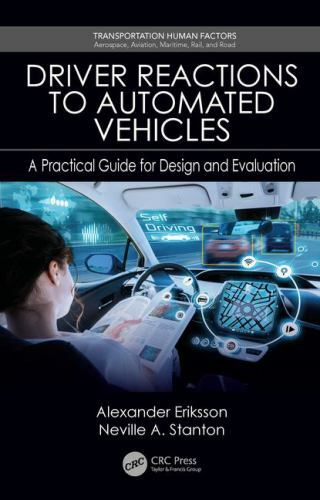
Driver Reactions to Automated Vehicles – Design and Evaluation Guide by Stanton and Eriksson (2018 Hardcover)
$ 64.03
Number of Pages:
158 Pages
Item Height:
0.6 in
Author:
Neville A. Stanton, Alexander Eriksson
brand:
CRC Press LLC
Series:
Transportation Human Factors Ser.
Type:
Textbook
Publisher:
CRC Press LLC
LCCN:
2018-026172
Subject Area:
Transportation, Computers, Technology & Engineering
ISBN-13:
9780815382829
ISBN-10:
0815382820
Publication Name:
Driver Reactions to Automated Vehicles : a Practical Guide for Design and Evaluation
Item Length:
9.4 in
Illustrated:
Yes
LC Classification Number:
TL152.8.E75 2018
Format:
Hardcover
Dewey Edition:
23
Intended Audience:
College Audience
Item Width:
6.3 in
Subject:
Engineering (General), Mechanical, Automotive / General, Automotive, Social Aspects / Human-Computer Interaction
gtin13:
9780815382829
Synopsis:
The introduction of vehicle automation has changed the role of the driver from an active operator, to a passive monitor. There are concerns regarding the safety and the ability of the driver to act as a fall back during failures or unexpected situations. This book covers the importance of considering driver variability when designing systems for human use. It provides an understanding of the contemporary issues related to human factors within vehicle automation and the effects on driver behaviour. It covers a novel way of looking at human-agent interaction from a linguistics perspective. It also discusses new perspectives on how to assess drivers, based on the full range of variability., Driver Reactions to Automated Vehicles focuses on the design and evaluation of the handover to and from driver and the automobile. The authors present evidence from studies in driving simulators and on the open roads to show that handover times are much longer than anticipated by previous research. In the course of the studies, Eriksson and Stanton develop compelling evidence to support the use of driving simulators for the study of handovers. They also develop guidelines for the design of handover strategies and show how this improves driver takeover of vehicle control. Book jacket., Driver Reactions to Automated Vehicles focuses on the design and evaluation of the handover to and from driver and the automobile. The authors present evidence from studies in driving simulators and on the open roads to show that handover times are much longer than anticipated by previous research. In the course of the studies, Eriksson and Stanton develop compelling evidence to support the use of driving simulators for the study of handovers. They also develop guidelines for the design of handover strategies and show how this improves driver takeover of vehicle control. Features Provides a history of automobile automation Offers a contemporary analysis of the state of automobile automation Includes novel approaches in examining driver-automation interaction Presents studies of automation in driving simulators Includes on-road studies of driver automation Covers guidelines for design of vehicle automation
Language:
English
Dewey Decimal:
629.04
Item Weight:
16 Oz
Table Of Content:
Introduction. The Chatty Co-Driver: A Linguistics Approach Applying Lessons Learnt from Aviation Incidents. A toolbox for automated driving. Take-over time in highly automated vehicles. Contrasting simulated with on-road transition of control. After-effects of driver-paced transitions of control. Augmented reality guidance for control transitions in automated driving. Conclusion.
Publication Year:
2018
This book is a must-read for anyone interested in automated vehicle design! It offers clear, practical insights into driver behavior and reactions, backed by solid research. The authors break down complex concepts into easy-to-understand guidance, making it useful for both professionals and enthusiasts. Highly recommended for improving safety and user experience in AV development!