Mort Kunstler "Sharpsburg War Council " New CUSTOM FRAMED Civil Art States MD
$ 36.96
Description
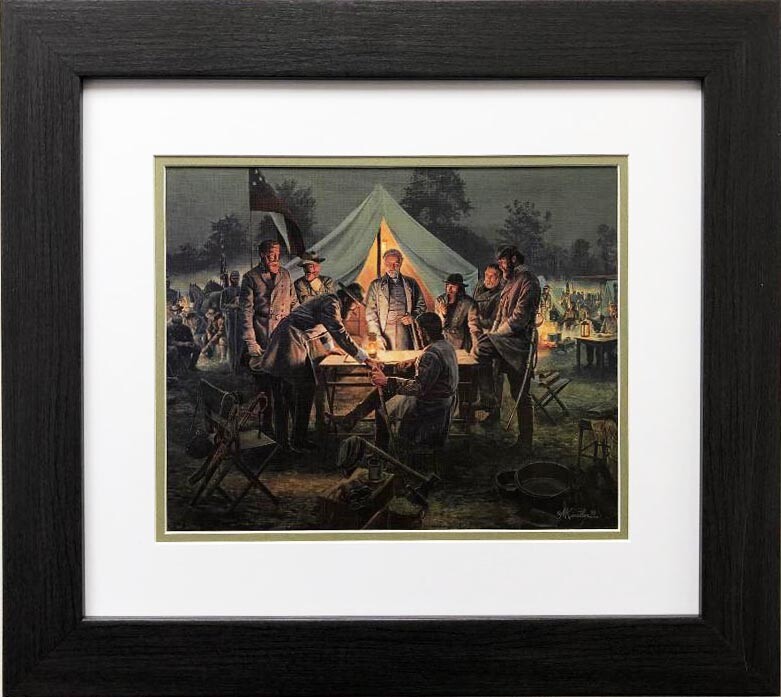
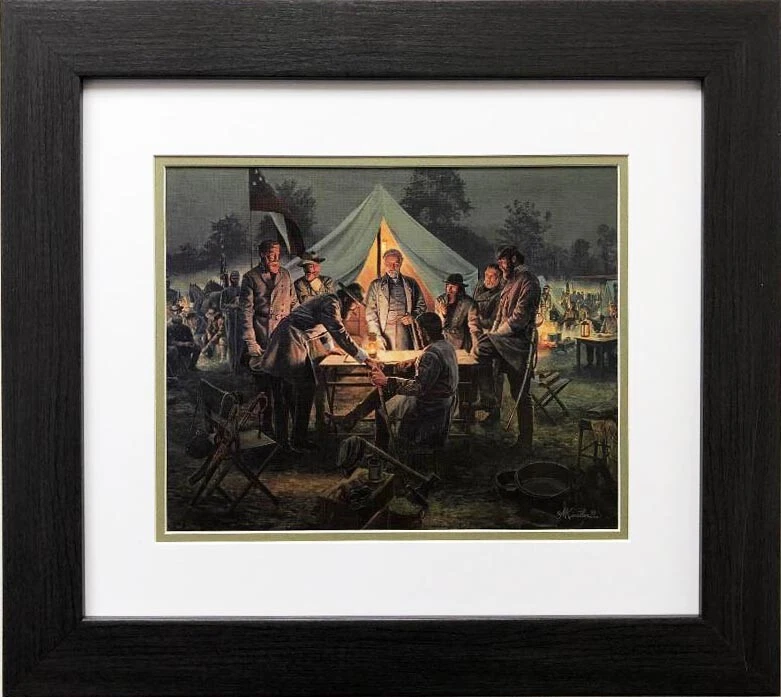
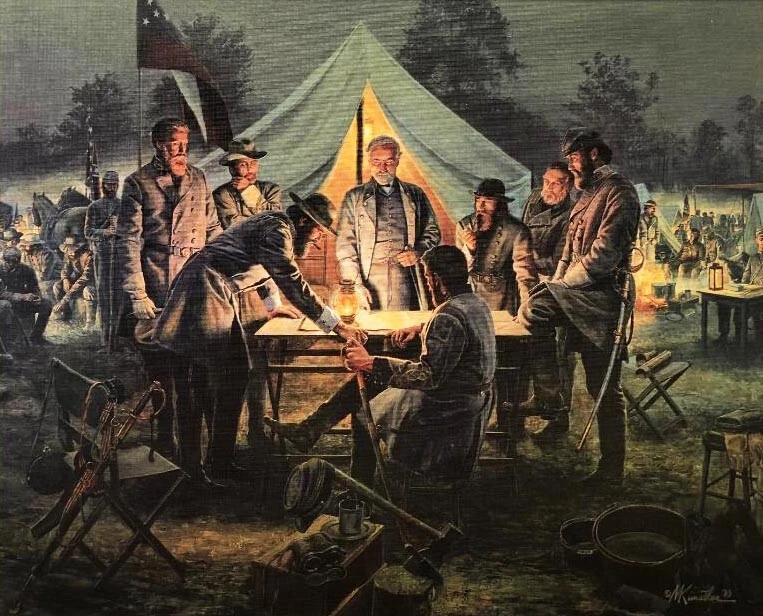
Mort Künstler "Sharpsburg War Council" This Artwork is: NEW CUSTOM FRAMED in a gray colored frame Double Matted in Green & White Plate Signed Framed Size : 17.5" x 19.5" Image Size: 11" x 9.25" Hanging hardware included on back of frame Looking for other framing choices? Contact us! Visit our store for other Mort Künstler listings... makes wonderful pairs or groupings! THE FRAMING ALONE IS WORTH OVER $125 Historical Information It had been the war's bloodiest day. The fighting had begun at dawn and had raged all day among the fields and forests near Sharpsburg, Maryland. General Robert E. Lee's army of 51,000 troops had faced a superior force of 75,000 Federals commanded by General George B. McClellan. who was also armed with a lost copy of Lee's troop deployments. By day's end, obscure local landmarks - the Sunken Road, Burnside's Bridge, the East Woods, Dunkard Church - had earned battlefield fame through fire and blood. When numbers were finally counted, the cost of a single day of battle at Sharpsburg would be more than 26,000 casualties. The common soldiers on both sides had again established their reputations for valor and sacrifice. On the night of the battle, Lee assembled his key commanders outside his headquarters tent. Should they stay and fight, or should they retreat? In the end, the hard choice was left to Lee - and he chose to face the enemy again the next day. When dawn came on the 18th, Lee's Army of Northern Virginia would be in place and ready to receive another enemy attack. Mercifully, the Federal Army of the Potomac was equally battered, and General McClellan chose to avoid further engagement. The two bloodied armies glowered at each other for most of the day, but the battle was not renewed. After sundown on the 18th, the Army of Northern Virginia withdrew from the field on Lee's orders. His attempted invasion of the North had been turned back, and his army had been severely mauled. But despite the superior numbers arrayed against them, Lee's legions had held their own - and they would fight again. Mort Künstler's Comments When you consider the war's most dramatic moments, one must be the scene at Lee's headquarters the night of the Battle of Sharpsburg. Lee had summoned the members of his high command to a war council outside his headquarters tent. It was virtually a "who's who" of the principal commanders of the Army of Northern Virginia. Jackson was there. So was Longstreet. And A.P. Hill, John Bell Hood, D.H. Hill, Jubal Early and others. What a great opportunity to paint a strategy meeting of Lee and his officers! Lee, standing in the center of the group, is pictured as the central and most commanding figure. (His hand is still bandaged from the fall he had suffered a few weeks earlier.) Leaning over the table is General James Longstreet. It was this evening that Lee referred to him as "my old war horse." Directly behind Longstreet are General Hood , hat in hand, and General D.H. Hill, who has hand to his chin. At the opposite end of the camp table from Longstreet is Hill's famous brother-in-law, "Stonewall" Jackson, contemplating the proposed strategy. Directly behind Jackson is General Early - with his hat off - and between Early and Lee is the irrepressible A.P. Hill. Seated with his back to the viewer is General D.H. Jones, who would die of heart trouble before the war's end. In the background of the painting are various staff officers, aides, and couriers, who are seen discussing the day's events. I used the lighting as a key element to make the painting match the drama of decision-making. The lamp in Lee's tent deliberately silhouettes General Lee, helping make him the center of attention. All the commanders await Lee's decision whether to retreat or again face the familiar enemy in the morning. Imagine so many great leaders looking to you for direction. Lee's burden must have been immense, but as always, he shouldered it with grace. Knowing the terrible cost this day's fighting, one can imagine the difficulty of his decision. To me, this event typifies the responsibility of command. Mort Künstler Biography Mort Künstler is regarded by many as the leading contemporary painter of Civil War scenes. His work is esteemed for its dramatic intensity and for an extraordinary level of authenticity that results from intensive research. Dr. James I. Robertson Jr., the noted Civil War historian and author of the biography, Stonewall Jackson, says, “Mort Künstler is the foremost Civil War artist of our time – if not of all time.” Harold Holzer, a senior official at the Metropolitan Museum of Art and one of the nation’s leading authorities on Abraham Lincoln and the political culture of the Civil War era, says of Künstler: “His art is terrific, and he’s attracted thousands of people to Civil War art.” Pulitzer Prize-winning historian James McPherson agrees, "Of all the artists working in the Civil War field, none captures the human element, the aura of leadership, the sense of being there and sharing in the drama